Students upset after Feb. 27 occupation restricted access to cultural centers
Nelson Hall East is home to various cultural centers on campus including the Umoja Center for Pan African Student Excellence, ADPIC-MENA and El Centro Académico Cultural de Humboldt.
On the first floor, resources are provided such as ELITE Scholars, the Career Center, Project Rebound and independent 24 hour study spaces. On Feb. 27, at 11 a.m., protesters occupied Nelson Hall East resulting in the administration closing the building and restricting access.
Protesters made demands for the university to divest from military funds, uphold a sanctuary campus and to support the Teamsters union and Palestine. While many students shared similar sentiments and solidarity, they criticized how the occupation interfered and negatively impacted the same community the protestors were trying to advocate for.
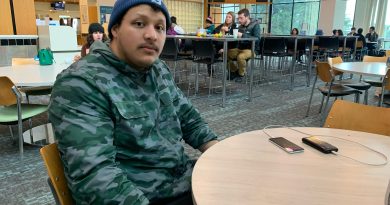
Dylan Frias, a student who spends a lot of time in the cultural centers explained that he was in ADPIC- MENA getting ready for the Chinese Lunar New Year event when someone came in and told them to leave.
“I don’t speak for everybody, but I do know that some people did have trouble. I just feel like it wasn’t the best spot to choose because of the fact that there’s a lot of cultural centers here,” Frias said.
Brennan Thompson, a student who frequents the Umoja Center, shared similar sentiments.
“A lot of students are employed academically here and in general it’s just kind of a safe space to decompress,” Thompson said. “It’s the only place on campus where minorities, and speaking for me, Black people, African Americans, have to not be under the pressure of a kind of white society.”
Thompson believes that although the administration shut down the building, protesters blaming them for shutting the building down felt like a “cop-out”.
“I think it’s important to acknowledge that the waters that we swim in as a culture are of white supremacy and if protesting is going to be done, in the name of minorities, it’s important that they’re not being adversely affected, in the kind of quest to do good,” Thompson said.
Thompson criticized the administration’s reliance on police, saying it contributes to feelings of insecurity.
“Given the nuance of how badly our communities tend to interact, and statistically, at least for Black people, when we meet police, we tend to either go to jail, get a fine or die,” Thompson said. “It didn’t make me feel good that it seemed the attention and focus, especially the security on campus, was around monitoring the hall. It kind of felt like the people that organized this protest don’t come into this hall and aren’t here. So why, all of a sudden, are we the main target of offense when, like, we didn’t do anything?”
According to Students for a Democratic Society (SDS), they did not make the decision to enter the building, but they did support the protesters’ demands. SDS felt that if Siemens Hall hadn’t been locked earlier that morning, protesters would have most likely chosen that building.
SDS said they care about those affected and will make a conscious effort to address student concerns and work with protesters to improve. SDS feels this could have been avoided if administration had met student demands.
“They’ve had lots of opportunities to do the right thing across a variety of causes, and that’s not what they’ve been doing,” SDS said in a statement to El Leñador. “So that sets a stage for more protest, because protest is the way that we can actually fight back to get our demands met. At a certain point, radical activism is the only avenue that you have left to actually get those gains, to actually get your needs met.”
Rafael “Rafa” Gomez, a student worker at the Indian Tribal & Educational Personnel Program (ITEPP), also felt the protest, especially the administration’s response, did more harm than good.
“If the situation escalates, gets national media attention, and some group like Proud Boys or some Students upset after Feb. 27 occupation restricted access to cultural centers by Pamela Hernandez other, alt-right group, wants to counter demonstrate or something like that, where are they going to show up?” Gomez said. “They’re going to show up to our centers. They’re going to target our communities.”
Gomez emphasized he was speaking as an individual, not for the entire community and hopes for more consideration of people’s actions.
“I myself engaged in this because I want to see them do better in the future,” Gomez said. “You know, because we live in some really messed up times, we’re all gonna need to work together.”