What non-citizen students need to know: information and tips from an immigration attorney
With current changes and enforcement of immigration policies, non-citizen students are experiencing increased anxiety about their safety. Since the start of 2025, 70 Cal State University (CSU) students have been impacted by visa revocations, as of April 15. Cal Poly Humboldt’s Communications Specialist Melissa Hutsell states that CPH currently has 18 international students, and as of April 15, none have been affected by visa revocations.
“University officials are closely monitoring the situation and are in communication with international students and the Chancellor’s Office. Due to shifting immigration policies, Cal Poly Humboldt is echoing guidance from the CSU Chancellor’s Office encouraging all students, faculty, and staff to think carefully about any international travel plans, and consider how travel could affect personal safety and the ability to return to the U.S,” Hutsell said.
As of April 30, the Trump administration has restored thousands of student visas. Many of these students had minor legal infractions such as traffic tickets and were not actively in lawsuits about recent mass terminations. The Department of Justice stated that they planned to reactivate the immigration status of students whose status had been recently revoked, and many of those students have already left the country and would need to reapply to study in the U.S.
How students are being impacted
El Leñador interviewed some CPH students about how they are feeling regarding current immigration policies and how it’s impacting them. Students shared similar sentiments of having a difficult time focusing on school because they are constantly worried about the changing policies and feeling isolated in society by anti-immigrant measures that make it harder to integrate. Some students stated that they feel unsupported by the university, noting that they feel emails from the university about their support haven’t been enough. Additionally, with the semester coming to an end, some feel a heightened anxiety about traveling for summer and returning to school in the fall.
Brenda Perez, the coordinator for El Centro on campus, shares how she is seeing students impacted by the current immigration climate on a daily basis.
“Most of our Latine students are coming from South California and Central Valley and for sure the ICE presence over there is more prominent so they are very concerned about their relatives,” Perez said. “Some of them unfortunately are taking a break from school to go check on their parents, because for their mental health it’s very hard to just be far from family right now.”
Perez is a part of a team working to build a Dream Center on campus that will be a resource for undocumented students in the future. As of now there is no specific launch date.
“The university and the president himself have been publishing communications and public letters to let students know they are in a safe space, not only as a sanctuary county, as a sanctuary city, and now with the Dreamers Center we are reinforcing those protections,” Perez said.
Legal advice and tips from an immigration attorney
Maricela Amezola, an immigration attorney based in San Diego is the founder of Amezola Legal Group. Amezola shared important legal advice and some tips, non-citizen students to know.
Protection in the dorms
The areas on campus that are open to the general public such as the SAC quad and sidewalks, are also open to federal immigration enforcement officers. In dorms, students have a freedom of privacy. If ICE knocks on an individual’s dorm room, they cannot enter without a warrant and will need your permission to enter.
“For the most part, immigration officers don’t have these warrants, because for that you need probable cause, if that person is first undocumented or has committed an offense against the U.S government,” Amezola said.
If you are living with multiple people, officers only need consent from one person that lives there to enter the room, even if it is not the person the officer is looking for. Amezola highly suggests if students are living in dorms with roommates, that they have these discussions.
“If they did have an actual warrant to come into the dorm room, they wouldn’t ask for permission, they don’t need permission because they have an actual warrant signed by a judge, but the majority of them don’t, which is why they need your consent,” Amezola said.
Interacting with ICE
Amezola states that every case is different and it is important that if you are concerned about your status that you find an immigration attorney to consult with. In the case that you do come into contact with ICE, Amezola notes the following:
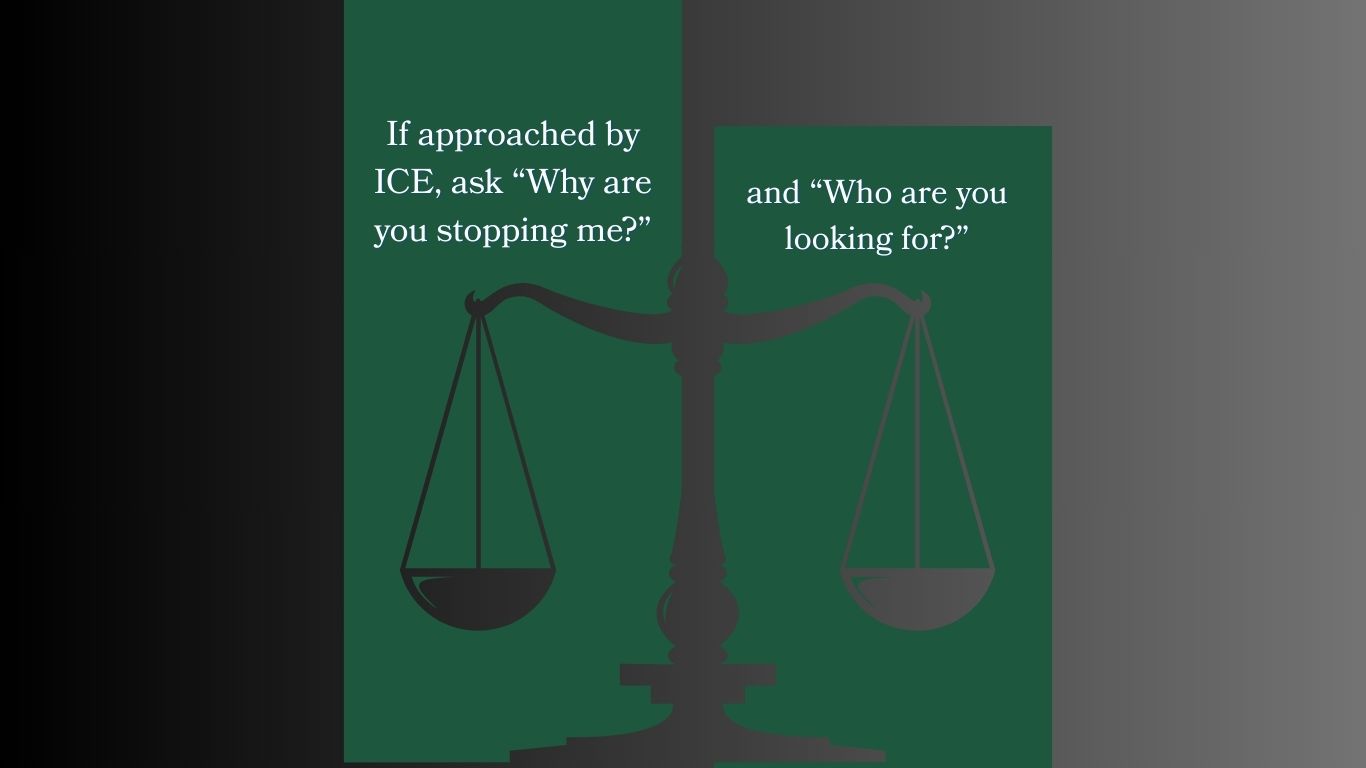
- If approached by ICE, ask “Why are you stopping me?” and “Who are you looking for?”
- If the person they are looking for is NOT you, state that it is not you and ask “Am I free to go?” and the officer must respond with yes or no. If the individual is the person the officer is looking for, then they must comply and they have the constitutional right to remain silent and to speak to an attorney.
- Unless the officer has a warrant signed by a judge, the individual can withhold consent for searches and seizures.
- In the case that ICE violates these rights, Amezola emphasizes the importance of paying attention to the details of the interaction, such as the officer’s name and how you were stopped, as they will be valuable in court.
“All these details matter for when you’re fighting a motion to suppress in immigration court, which is to suppress the evidence that led to them finding out it was you unlawfully and now you’re being deported or trying to be deported,” said Amezola.
Identification at protests
Amezola emphasizes that under the current presidential administration, non-citizen students involved in protests for the Israel and Palestine war are being brought into detention and questioning. She calls attention to the recent cases of students being identified through cameras or facial recognition, and that agents have then determined an individual’s status, thus bringing them into questioning.
On April 9, the U.S. Citizenship and Immigration Services stated that the Department of Homeland Security will “begin considering aliens’ antisemitic activity on social media and the physical harassment of Jewish individuals as grounds for denying immigration benefit requests. This will immediately affect aliens applying for lawful permanent resident status, foreign students and aliens affiliated with educational institutions linked to antisemitic activity”.
Travel and social media
Circumstances for travel vary with different statuses for non-citizens.
“Green card holders should have no issue. They are protected unless the green card holder has some type of protest or situation happening in their phones or in their social media, because the government did issue an executive order indicating that social media will be scanned [for] every non-citizen,” Amezola said. “Regarding the dreamers, they are not allowed to travel outside of the United States, so travel inside of the US is fine.”
For any non-citizen, especially students on student visas, Amezola advises that if they have any unpaid tickets such as driving, parking, or DUI, that they take care of it immediately before travel.
“They need to go speak to an attorney before they fly out. Those are the students that are now being flagged,” Amezola said.
For more information about immigration rights and resources, financial aid, career development, cultural centers and campus liaisons for undocumented students visit the following: https://www.humboldt.edu/immigration/dreamer-student-resources
For free immigration legal services visit: https://www.humboldt.edu/immigration/free-immigration-legal-services