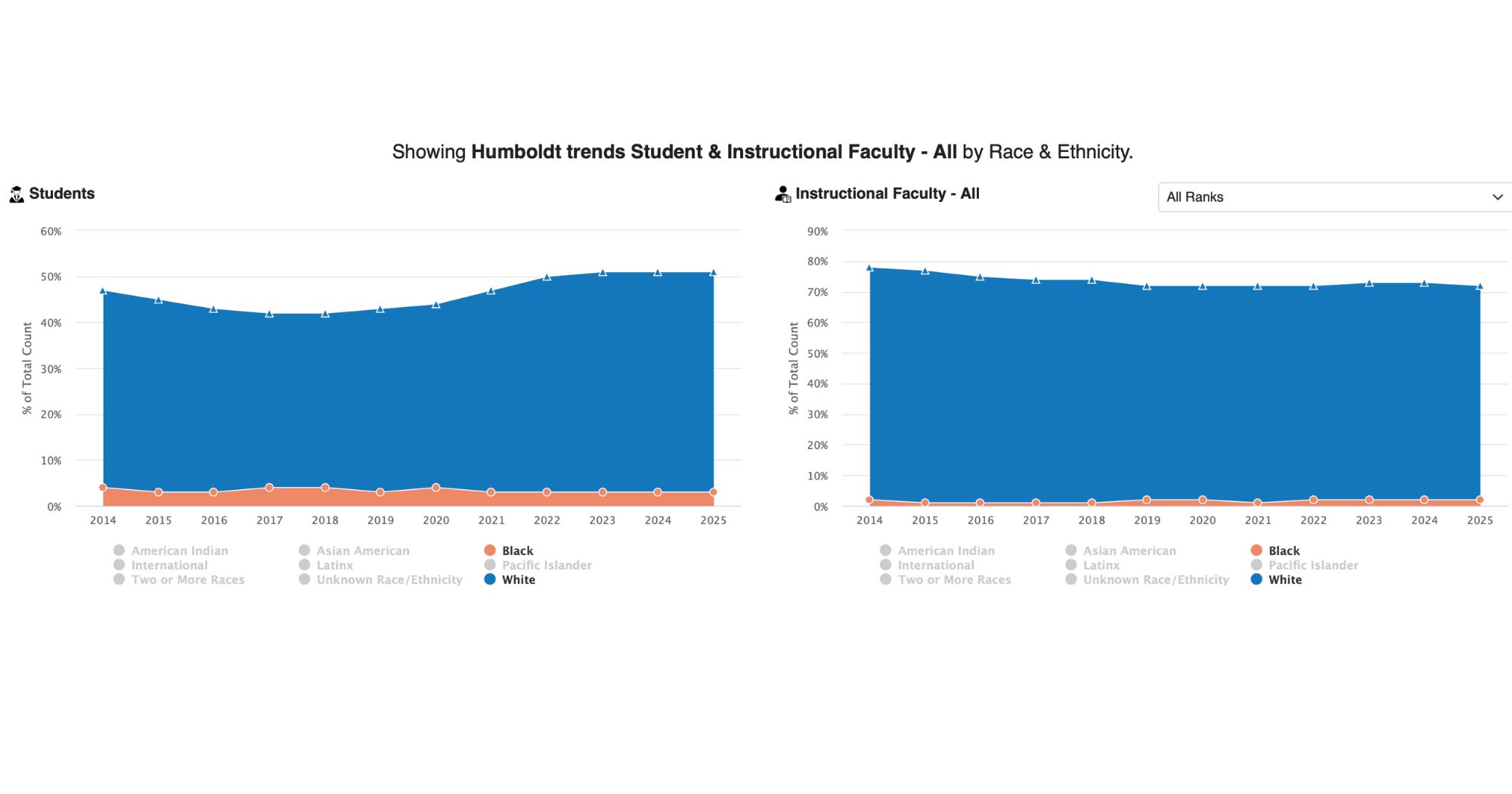
CPH Black student, staff and faculty enrollment and retention trends
From 2018 to 2025, Black student retention has gradually declined at Cal Poly Humboldt. In fall 2025, Black students represented 2.7% of all enrolled students, with this decline notably beginning after fall 2017.
In fall 2024, CPH’s retention rates for students who identify as African American dropped from 94.4% to 61.1%, throughout the span of a semester to a year.
Chrissy Holliday, vice president for Enrollment Management and Student Success, explained that various universities across the nation have seen a decrease in student enrollment over the past years. She stated it may be due to various factors such as COVID-19, and many more students preferring to pursue community college as a more cost- efficient option.
“The good news is that our student enrollment is up almost 4% from last year — the fourth consecutive fall semester in which we have shown growth,” Holliday said. “Enrollment among students of color has been increasing at Cal Poly Humboldt over the past few years. As more new students select Cal Poly Humboldt, we are seeing our incoming classes becoming increasingly diverse – 41% of new students in fall 2025 self- identified as racially or ethnically diverse, compared with 37% the two previous years.”
CPH has various initiatives to support students from diverse socio-economic backgrounds. In fall 2025, 44% of new students were Pell Grant recipients, which is 3% higher than last year, and 7% higher than fall 2023. CPH also saw the percentage of first-generation students rise to 43.75% which is around 3% higher than fall 2024.
Student experiences
Some students ultimately feel that building community and engaging in programs like Umoja Center for Pan African Student Excellence, a cultural center on campus, are what have kept them here.
Breann Burgess, a junior environmental management major, shared her experience growing up in Humboldt. Out of all the schools she grew up going to locally and at College of the Redwoods, CPH has been a bit more diverse.
“I can see people’s concerns and hesitations about wanting to come to a school in this type of area, but I would say, if you are willing to put yourself out there you will find your community and I would say that for me, it has been a pleasure to be here and I feel very safe and welcomed,” Burgess said.
Other students similarly shared how the community has helped them grow at Humboldt.
“Working at the Umoja Center saved my life,” said Delaena Montez, a student- athlete majoring in critical race, gender, and sexualities studies (CRGS). “I had no direction for life and my advisor offered me guidance and true genuine care for my well-being.”
Montez feels the retention aspect of students of color can be overlooked.
“I believe that Cal Poly Humboldt has committed to creating a space for diversity, equity, and inclusion,” Montez said. “Now, how it’s being sustained goes overlooked.”
Representation amongst faculty
In fall 2025, eight tenured or tenured track faculty out of 222 identified as Black along with the four Black lecturers out of 295. Montes shared that as a CRGS major she has been “fortunate enough” to have had two Black professors, but reflects on how this may not be the same experience for other majors.
When asked whether having more representation amongst faculty could benefit students, Shawna Young, interim provost and vice president for Academic Affairs, emphasized the importance of having diverse faculty on campus.
“We understand the need for hiring faculty of all backgrounds,” Young said. “Including a range of perspectives in and out of the classroom not only enriches the learning experience, but also the campus community. To that end, we make efforts during our recruitment process to attract qualified prospective candidates from a wide variety of backgrounds.”
Students seeking out resources
Alexus-Harrelle Deshazier, a Humboldt State alumni and now Umoja’s program coordinator, shared her experience throughout the years on campus. She credited her involvement and connections at RAMP, EOS/SSS, and TRIO Upward Bound, for helping support her journey throughout college. In these programs, she discovered a love for engaging with students and supporting their visions of success.
“I have always been a person to choose positions that speak to my personhood and passion, and my role as the coordinator for the Umoja Center is a testament of that,” Deshazier said. “ I believe had it not been for the inception of this space in 2015, the vision of Black student success and the engagement of students who look like me, would look a lot different. I am grateful to be part of that legacy now, as a professional.”
Deshazier explained that with her role, she has the opportunity to lead a community and together provide a home away from home for students who may be missing cultural connections. She believes it is necessary to uplift programs, provide daily support and services for students across the CSU to increase overall Black Student Success, a CSU initiative to support Black students’ retention, community and academic success.
“I am proud to be someone that Black students can go to and see themselves,” Deshazier said. “And to lead a student staff that supports these efforts for not only their professional development, but also because they know the value that this space has held in their own lives.”