CPH report finds less Latine students, rising Latine faculty
News Noticias CPH report finds less Latine students, rising Latine faculty by Tim Nakautoga Cal Poly Humboldt has maintained its status as a Hispanic Serving Institution (HSI) for 12 years in a row, but the percentage of Latine students is slowly declining over the last few years. Latine faculty tenure-line positions are steady and Latine lecturer numbers are increasing, according to university research.
CPH’s Institutional Research, Analytics and Reporting department (IRAR) released their enrollment demographic data for fall 2025. The annual public report details statistics among the student population like ethnicity and race, gender, region of origin and class levels. IRAR data reports Latine students as self-identified “Hispanic or Latino.”
Students
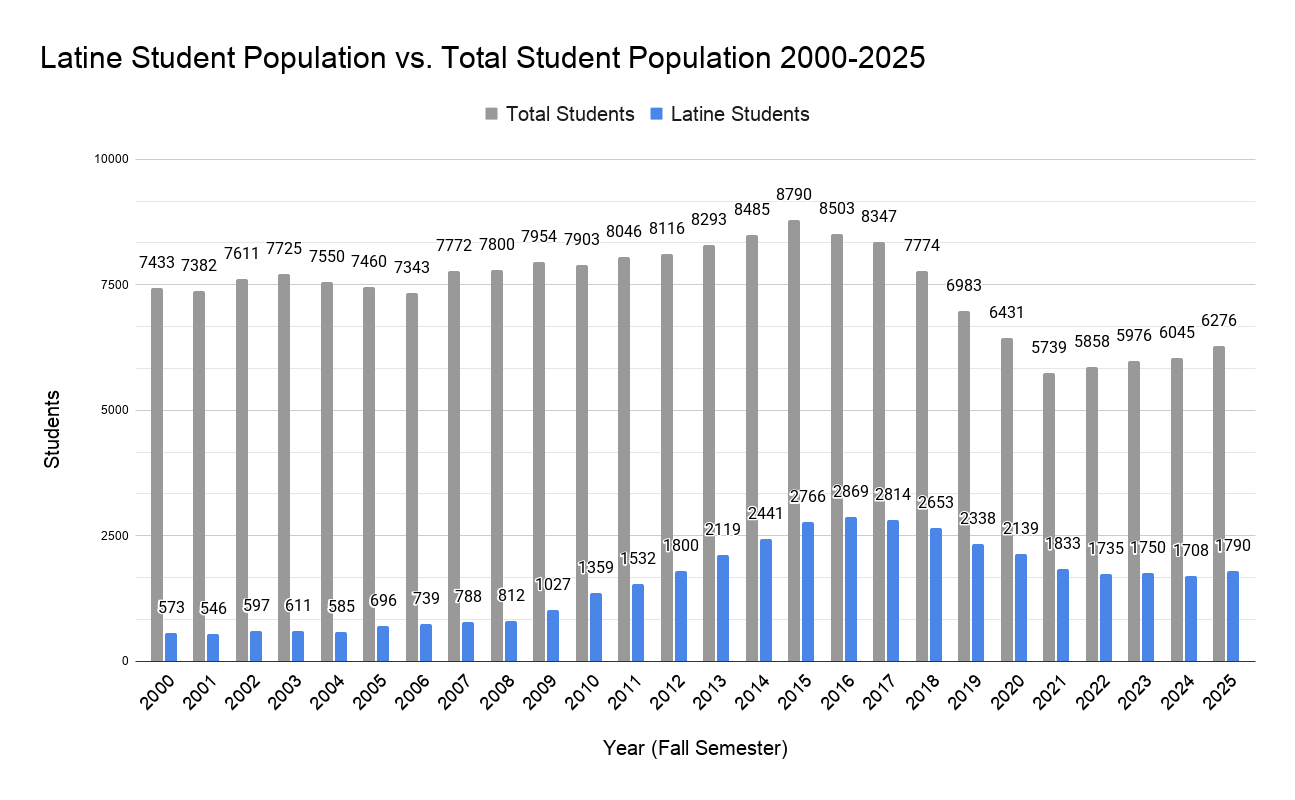
Any school’s status as an HSI is dependent on the overall Hispanic or Latine student population remaining above 25% of the overall population. While CPH is above the cutoff at 28.52% in fall 2025 and is only slightly higher than 2024’s rate (28.25%), both are lower than the 34.14% in 2018, which had the highest percentage of Latine students at CPH on record. In fall 2025 the student population total was 6,276 and the Latine student population was 1,790.
Faculty
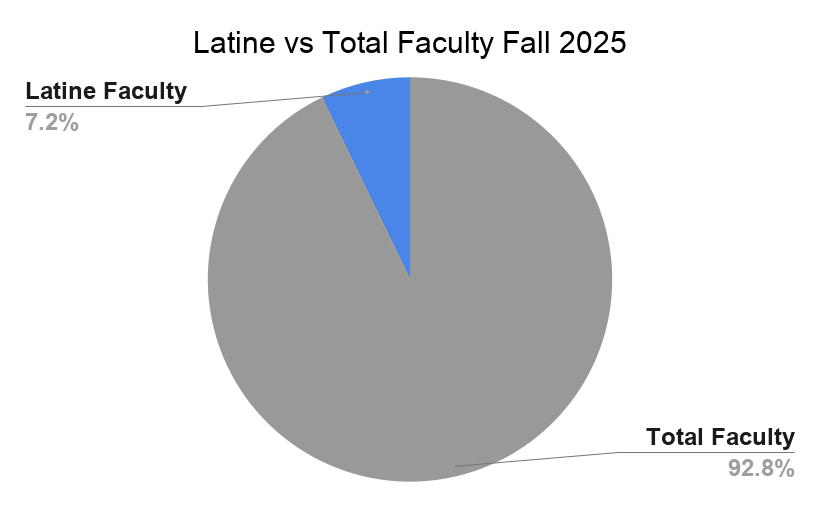
In 2025, there were 40 Latine faculty at CPH, 16 were tenured or tenure-line and 24 were lecturers. Latine faculty comprises 7.74% of the 517 faculty members.
Student percentage on decline
The university’s Marketing and Communications office highlighted the need for a diverse student population.
“The University recognizes that representation matters to students, staff and faculty,” said Aileen Yoo, Director of News & Information. “We strive to attract a broad pool of candidates with a wide range of perspectives and experiences, knowing these enrich our campus community and the student learning experience.”
There may be many explanations for the decreasing percentage of the Latine student population since its high in 2018. Rosamel Benavides-Garb, associate vice Graphics by Tim Nakautoga president of the Office of Diversity, Equity and Inclusion said, “This is a really important conversation because something happens also in between, we became a polytechnic university.
And then we have COVID. And then we have a national administration, right? That made you think twice if you were gonna leave home to come to a rural distance, an isolated place and how that impacts your life and the life of your family. So there’s some multiple conditions here that may help us to understand this.”
Regardless of CPH’s Latine population, all federal funding for grants serving HSIs were halted in September 2025. Benavides- Garb said this left some prospective applicants and recipients of that federal funding without money that would have been used for the programs.
Campus Life
Despite the cuts to funding, some Latine students on campus said the campus is making efforts to make them feel at home.
“I notice that a lot of the time when I got homesick, it’s just me not seeing people who look like me,” said CPH student Vienna Koehler. “So taking advantage of the resources or clubs and centers that they have for Latine students is really nice.”
In 2025, CPH was one of five campuses nationwide that won the Seal of Excelencia, an award that recognized efforts for Latine students’ success. Students on campus echoed that sentiment.
“Obviously, I just don’t see many of my people or much of my culture here, but I do see some [Latine] students,” said CPH student Jacqueline Zuniga. “I definitely feel like a minority here, but I don’t feel like I don’t belong.”
Despite this culture shock and homesickness, students expressed gratitude for the resources available on campus, including El Centro Académico Cultural de Humboldt and other initiatives that exist on campus to serve the Latine community.
Benavides-Garb recalled joining the campus in 1991 and being one of three Latine faculty. He feels proud the Latine faculty is taking up more space overall and sees Latine representation as an important aspect of being a student anywhere. “The question is representation at the end of the day, and this concept that students will do better [and] feel more represented by faculty that look like them, that have [a] lived experience like them,” said Benavides-Garb. “We’re occupying spaces that historically were not designed for us to occupy.”