
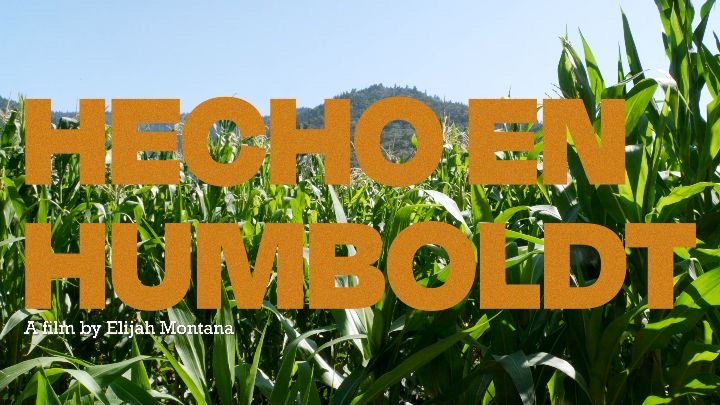
Behind the Lens of ‘Hecho en Humboldt’
Northern Humboldt’s coastal valleys, the heartbeat of Humboldt County, aren’t found in its misty scenery, but in the hands that nurture its soil. In a short film called “Hecho en Humboldt”, filmmaker Elijah Montana, also known as El Miklo, turns his lens toward local farmworkers, artisans and organizers who sustain the region’s food system.
Montana moved to NorCal from Los Angeles with his wife, connecting with Aquilli Metzli at a community gathering at La Ciendita. Over the course of a year, he recorded the daily labor and cultural resilience of friends and neighbors cultivating milpa crops across Loleta, Hoopa, Carlotta, Blue Lake and Fickle Hill.
“I really didn’t know what Hecho Humboldt was, what it was gonna look like. I was like, ‘Let me just start this documentary,’” Montana said. “I think, to me, what I was loving to see was showing people grow food in a different way.”
For Montana, the film was never about big production, but about capturing intimate moments of everyday cultural practices and food sovereignty.
“They’re not like farmers with a bunch of resources, the folks in the film, it’s practicing your culture, it’s a form of prayer,” Montana said. “It’s a form of connecting with the Earth. It’s a form of, I say, resistance, a form of refuge. And so, those were the things I was hoping to be able to capture through the film.”
“Hecho en Humboldt” highlights Octavio Acosta, co-founder of Aquilli Metzli, father, owner of La Ciendita in Arcata and musician for “Hecho en Humboldt”, using Mesoamerican instruments like harana and ayoyotes. Filmed at Wild Rose Farm in Blue Lake, Acosta’s story illustrates the quiet beauty and real-world hurdles of dry farming maize without irrigation during particularly
dry seasons.
Montana’s most powerful dynamic to capture on camera was Acosta’s role as a father, filming him alongside his daughter, passing down agricultural knowledge and cultural heritage.
“I think Elijah is really good at capturing the soul of what’s going on in a situation. I was working for UIHS [United Indian Health Services] and I invited him to a project,” Acosta said. “When he filmed with some elders and some youth, and he was just able to capture that soul and he captured the inspiration.”
Through frames capturing everything from seed to harvest, “Hecho en Humboldt” reminds its audience that cultural survival and food sovereignty begin when community members gather to protect their roots.
“It’s acorn land. This is salmon land. Milpa is an Indigenous practice, but it is being practiced in unfamiliar soil,” Montana said. “And so I wanted to be able to explore what that means and, you know, what are the ethical quandaries to explore.”
There is a planned showing at the Arcata Theatre Lounge on November 14, 2026.


