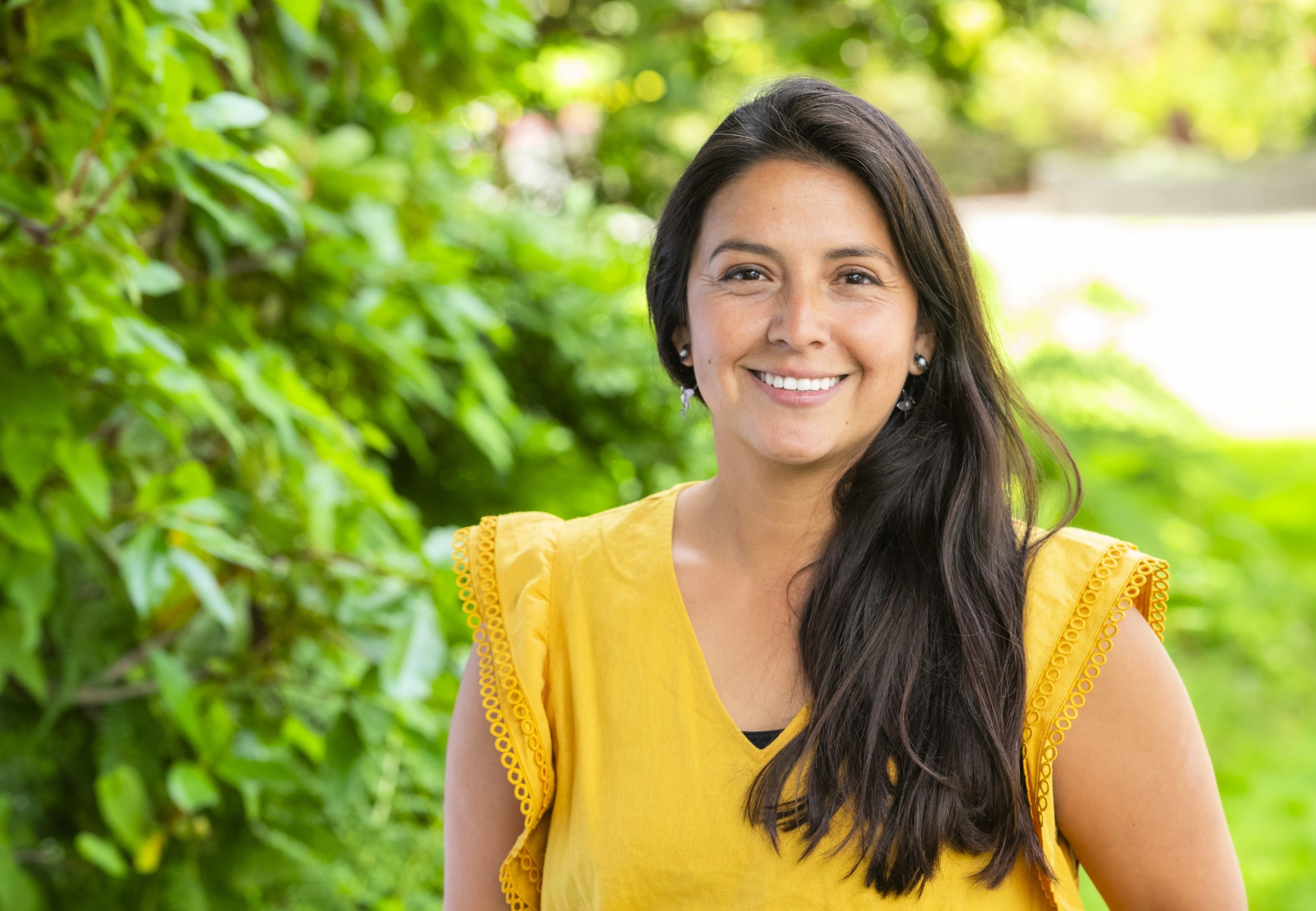
Department of Environmental Studies welcomes new Assistant Professor Sarah Rios
Professor Sarah Rios has joined Cal Poly Humboldt’s Department of Environmental Studies this fall. Since her move to Humboldt in August, Rios has enjoyed being back in her home state after teaching at the University of Wisconsin-Madison for several years.
Reflections and childhood
Growing up in the Salinas Valley, Rios described the pull to environmental and health justice as interruptions and reflections throughout life that guided her. Rios explained that having family members who are farmworkers added perspective and layers to her work.
Joining her grandmother harvesting strawberries and other crops, Rios quickly learned about exposure to pesticides and harmful chemicals when she was told to stop eating the fruit.
“I kind of carried those lessons that we had to work in these places, that there’s nutritious food that is also the most toxic food,” Rios said.
With these experiences from childhood, Rios continued to foster a curiosity about the disproportionate ways communities experience environmental and health injustice, and racism.
“When I was older, I came to a realization that ‘oh, you know, when you’re in elementary school, every time you go outside, it would smell like pesticides or manure, like these different things that they would add to the fields in Salinas,” Rios said. “I was like, ‘That’s not the case for everybody, right?’ Not everybody goes outside during recess and gets a whiff of all of these toxins.”
Being an educator has always been at the forefront, but upon completing a K-12 youth deaf education program and getting into a master’s program, Rios was further prompted to reflect on her personal experiences, realizing that she held knowledge and a deep curiosity about the environment.
Curiosity and community
Rios is currently working on her upcoming book project titled “Diseases Have No Eyes: Valley Fever and Environmental Health Justice,” which brings together parallel issues experienced by farmworkers and formerly incarcerated people. This project analyzes how these communities are impacted and navigate systems of interlocked oppression, including lack of access to health care, poverty and environmental injustice.
Rios was deeply inspired by activists in the Central Valley who worked closely with farm worker communities, focusing on environmental and health justice, and raising awareness of Valley Fever. This research approach has informed her professional and teaching philosophy.
“ The knowledge of people who are not credentialed experts is incredibly valuable to our understanding of social environmental issues,” Rios said. “And it gets discounted as like stories or it gets discounted often as inexpert and not knowledgeable, but it can offer an opportunity to collaborate with people who have expertise and kind of generate new solutions, alternative solutions.”
For Rios’ work, community-based knowledge is essential. She believes asking questions and challenging assumptions to find what lies underneath make for strong research skills, and she advocates for her students to do the same.
Sarah Jaquette Ray, professor and department chair of Environmental Studies, has worked on campus for years to develop curriculum and programming that focus on the social justice dimensions of environmental problems. Ray highlighted how Rios’ addition to the department is impactful to students and campus community.
“Dr. Rios shows up with a huge heart, lots of passion for environmental justice and for our students, deep ties to California, and lots of energy to keep building and creating community and initiatives in our department and the community,” Ray said.
Rios underlined that in this current moment, presence is necessary for education and community building.
“In our political moment, there’s a lot of anti-immigrant, anti-trans, anti-DEI, and I wanted to say that showing up to learn and to be in community at school is a radical thing at this moment because there are so many threats to people, to our selfhood, and also the people we love,” Rios said. “And so I wanted to just encourage students to keep showing up to class, and being in community.”