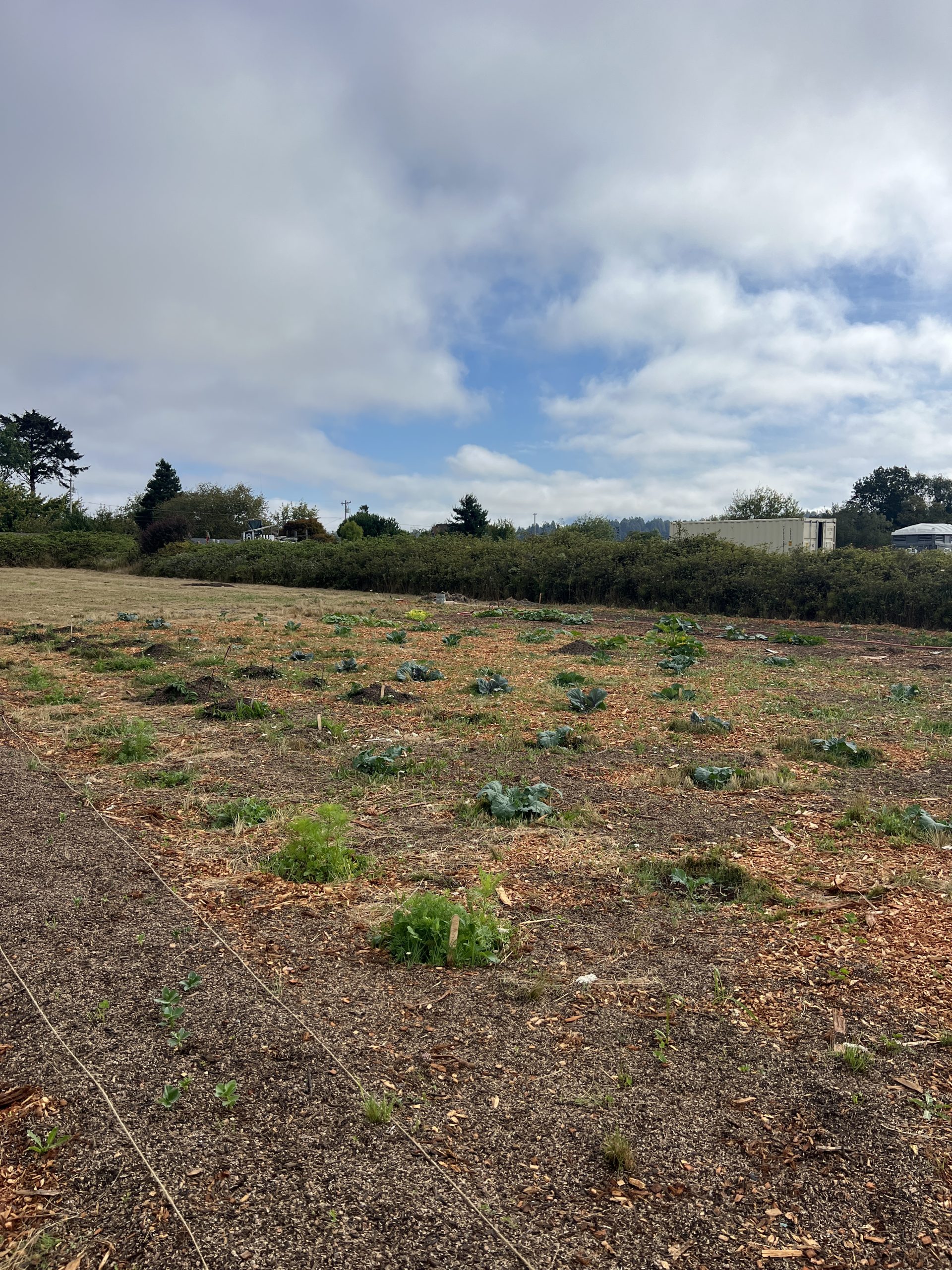
Student farm grows from new agriculture program set for fall 2026
As a part of the Critical Agriculture Studies and Agroecology (CASA) program set to roll out in fall 2026, Cal Poly Humboldt allocated two acres of land for a new student farm. With pumpkins in the ground and soil building up, students are already rolling up their sleeves for a unique hands-on learning experience.
The farm will focus on traditional and BIPOC ecological knowledge, medicinal plants and land based healing. The Program Leader of CASA and Associate Professor in the Department of English, Renée M. Byrd, founding program leader of CASA, highlights how the roots of the program and farm are centered around engaging in diverse practices and social justice through farming.
“I think questions around healing and climate justice are really coming to the center of our social movements and so there is a desire I think for farming and gardening to be in our activism,” Byrd said. “We are starting to see that healing is a political thing and that relationships to land and growing our food, medicines, flowers and seeds, that’s a part of that process.”
The farm will have space for a variety of community programs including the Rou Dalagurr Food Sovereignty Lab on campus and Aquilli Metzli, a new local cooperative. The farm has plans to donate a significant amount of produce to OhSnap!, the campus food pantry. The curriculum will largely influence the types of farming put to practice, as students discover what they are passionate about.
“I designed the curriculum to be really intentionally flexible, both so we can kind of scale up our agriculture offerings at CPH in a sustainable way, but also so that students can craft a program that is tailored to their interests and what they want to do,” Byrd said.
Cinthya Ammerman, Assistant Professor of Native American Studies, a member of the farm’s planning committee and one of the developers for the CASA curriculum, was inspired by her own experience of working on a community farm in graduate school at UC Davis.
“I’ve carried that experience with me into here and I’ve longed for that sort of space here for students to share that experience,” Ammerman said. “It’s a different learning that happens on the land that you can’t get from the classroom.”
Jeffrey Crane, Dean of the College of Arts Humanities and Social Sciences, emphasizes the importance of introducing this platform into the community.
“There is some urgency in getting this farm started as we know that members of our campus community experience hunger regularly. A majority of harvests will be donated to Oh Snap to help these folks. Moreover, with the current political situation the national food system and network is imperiled and getting the farm launched quickly helps us be more resilient in the face of current and future crises,” Crane said.
Botany major LaTasha Amos has been a farm assistant since the beginning of July and plans to join the CASA program next fall.
“I have been wanting this opportunity to know how to start a farm, know all the ins and outs, the experience of it as well,” Amos said. “Its been really beautiful.”
Amos recently harvested her first zucchini and cucumber. This process was eye opening, as she reflected on her own life watching her plants grow.
“To see the growing process has a really philosophical process on me, I don’t have to be perfect in the way that I grow, I don’t have to have the expectation that I am going to be something until I’m ready,” Amos said. “The process of growing something really helps to ground me in how to navigate my choices and how I want to live.”
For more information about the farm or program contact Renée M. Byrd: Renee.Byrd@humboldt.edu or visit https://www.humboldt.edu/academics/programs/critical-agriculture